Language and Learning
Toys and Play Encourage Development
Although babies don’t play with each other at very early ages, they watch older children play with toys. What is a toy? Toys are what we play with.
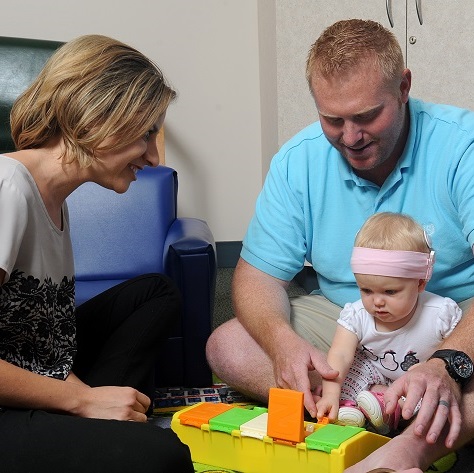
Mom and Dad are Definitely Toys!
As parents, you are the first and perhaps the child’s FAVORITE playmates. Playtime with your little one is a time for joy, laughter, learning and exploring.
- Joyful play interactions foster learning and social development
- By playing with you, your child learns how to play with others – an important building block for later play with peers
- Play experiences with parents and peers help children become happy, well-adjusted, and creative
More information on playing with babies and toddlers.
Toys are Toys
When babies are in their first year, appropriate toys change with every month. From mobiles to keys to stacking cups to sorting boxes, your baby wants more and more challenges.
More information about selecting age appropriate toys.
Safe Household Objects are Toys
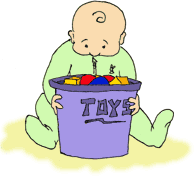
Big plastic lids and washed out BPA-free plastic bottles can be as much fun as commercially made toys.
Water is a Toy
Outside in the wading pool (with you right there!) or in the bathtub. Water is fun from a very early age.
Grass, Rocks and Leaves are Toys
When you go outside, your baby can see new and interesting objects from the stroller or carrier. You can choose what to pick up and bring closer. As your baby grows into a creative child and begins to pretend, those sticks can turn into horses, and the rocks can become little houses on a cleared spot of earth.
Clothes are Toys
Nothing is quite as fun as popping your baby’s head out of the neck hole of a shirt as you say or sign, “Where are you? THERE you are!” Hands, feet, and whole bodies disappear and reemerge during dressing and undressing, and everyone knows that shoes and socks are designed to be taken off.
This can be a good time for learning the names of clothing and body parts. As your little one grows, clothes will be fascinating toys for Peek-a-Boo, dress up and make believe.
What are Children Learning During Playtime?
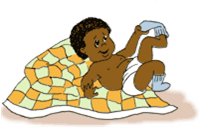
“Oh, boy – when I get this off, I can chew on it and play with my toes!”
What does baby learn?
- The feat of finding his feet! This takes eye-hand coordination and problem solving skills.
- A baby’s mouth is a “touch center” that has lots of nerve endings. Mouthing tells a baby a lot about what he puts in his mouth.
“Oh, boy – when I get this off, I can chew on it and play with my toes!”
What is baby learning?
- Eye-hand coordination
- Thinking skills as he solves new problems
- That his actions cause things to happen
“If I pull my blanket over me, I bet somebody will play peek-a-boo with me!”
What does baby learn?
- To start up games with others
- That she can socialize with others
- That she can take turns with family members playing “peek,” smiling and laughing.
- Conversations are a game of taking turns too, so she is learning to take part in conversations.
- That people are there even when she can’t see them.
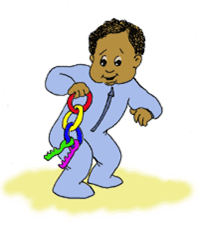
“Wow, I leaned over and picked this toy up. When I shake it, it makes sound! I can do it again!”
What is he learning?
- Eye-hand coordination
- Fine motor skills
- Large muscle skills
- Balance
- That his actions cause things to happen
- That if he turns and listens, he can hear the sounds with his hearing aids or cochlear implant
Resources to Help Parents Plan Playtime
Although babies do a lot of playing on their own, sometimes you can plan their play. If you choose activities and toys appropriate for your baby’s age and development, you can create special playtimes that stimulate your baby’s development of communication and thinking skills.
There are plenty of books and other resources that provide ideas about what your baby might be able to do at various ages.
Books about Play and Toys
- Your Baby’s First Year Month by Month, by Alison Mackonochie, is an exciting mix of pictures and information.
- Baby Tips: Baby’s First Year, by Jeanne Murphy, serves up information in small, digestible bits, including many suggestions for play and toys.
- Baby Games: The Joyful Guide to Child’s Play from Birth to Three Years, by Elaine Martin, organizes games and toys by type and appropriate age.
Websites about Playtime
- NAEYC (National Association for the Education of Young Children): Play and Children’s Learning
- Zero To Three: Tips and Tools On Play
- Pinterest: Baby/Toddler Play Ideas
Apps and Other Technology
- Free Toddler Apps on Amazon
- BestKidsApps.com
Adapting Resources for Your Child
Of course, most baby books and other resources are written for children with typical hearing in mind. But you can use the information for your own needs and those of your child by following just a few, practical steps:
Make the Language Provided In the Books Accessible
- Use your face and body with expressions and gestures.
- Speak naturally and close to the child.
- Learn the signs (if your baby is signing).
- Quiet the environment and make sure the implant or hearing aid batteries are working.
Maximize Visual Access Tips
Use Language as You Play
- Give your baby opportunities to do the same.
- Try to be encouraging without being demanding.
- Provide a lot of repetition.
Use Toys Simultaneously
- Choose a few toys at a time and alternate them to keep the toys and the language interesting.
- Choose experiences and routines where games play a natural part.
- Provide variety by alternating experiences or by adding something very small that is new.