

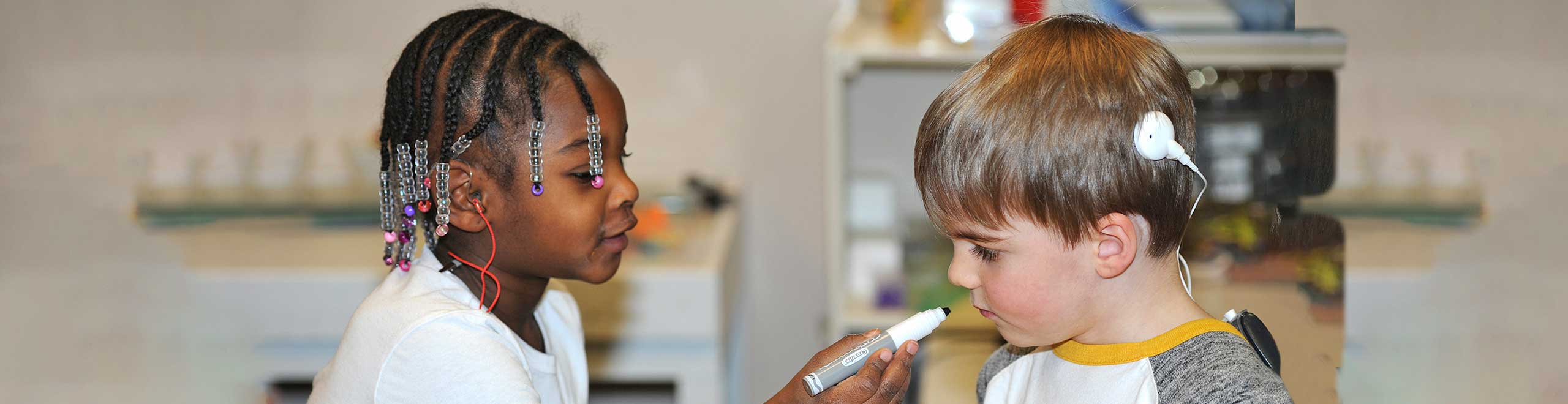
Hearing Devices
Pros and Cons of Cochlear Implants
Cochlear implant pros and cons are important to consider while weighing hearing amplification options for your child.
Pros
- Hearing improvement: Cochlear implants can improve hearing and speech perception for your child. People with cochlear implants may still use lip reading and sign language to enhance speech perception and communication.
- Speech Development: Cochlear implants help improve the clarity of the child's speech and future development of listening and spoken language skills. Parents can take several steps to maximize outcomes for children with cochlear implants.
- Future learning and career opportunities: Children with cochlear implants can hear better in the classroom, usually with the help of assistive technology. CI's may also benefit children as they age and open doors to new career opportunities.
- Safety: One of the most notable benefits of a cochlear implant is the ability to hear potential dangers or alerts such as sirens and other important sounds.
Cons
- Surgery: As with any surgical procedure, there are
- Cost: Many insurance companies will assist with the
- Background noise: Children will still need support hearing and communication in background noise. Assistive devices can help hearing in places with lots of background noise (classroom, car, zoo, etc).
- Maintenance: Cochlear implants require ongoing support and maintenance. This can include monitoring and replacing equipment, changing batteries daily, and following up with programming appointments.
- Outcomes and hearing levels differ for everyone: The benefit of a cochlear implant is not immediate, and each child will have varied performance.
- Childhood Activities: Children with cochlear implants can participate in almost all common childhood activities. It is important to utilize waterproof cases or remove the device when the processor could get wet or be submerged under water (i.e., swimming or in the bathtub). Precautions are recommended to protect the device from damage, on plastic slides, playgrounds, and ball pits. It is also recommended that the child use a helmet while bicycling or playing other sports.
Risks and Limitations
Surgical Risks
- Some patients experience reduced balance function following surgery. This can last a short period or can affect balance long-term.
- A small percentage of implant patients have reported an increase of tinnitus (ringing in the ears) after the surgery compared with their previous experience.
- Risk from anesthesia needed for the implant surgery is slightly higher in infants and young children compared to adults.
- Slight chance of damage to the facial nerve or the chorda tympani nerve. Two nerves that pass through the middle ear space.
Cochlear implant recipients are unable to undergo certain medical procedures, should the need for these occur at some later date. These include:
- Electrosurgery or diathermy in the vicinity of the implanted portion of the cochlear implant
- Electroconvulsive therapy
- Ionizing radiation therapy
- Most internal devices contain a magnet that is designed to be MRI (Magnetic Resonance Imaging) compatible but it is still important to check with the surgeon before an MRI is completed on a child with a cochlear implant.
Cochlear Implants and Meningitis
Children with cochlear implants have a higher risk of contracting the type of meningitis caused by Streptococcus pneumonia (pneumococcus) than children who do not have cochlear implants. Therefore, the Centers for Disease Control and Prevention (CDC) recommend:
- Pneumococcal vaccinations for all children with cochlear implants.
- Specific recommendations for the timing and particular type of vaccination vary depending on the child's age and vaccination history.
For additional information about these vaccinations:
Problems with Cochlear Implant Internal Components
There is a chance of a problem occurring with the internal portion of the cochlear implant system after it is implanted. However, based on reports from the current cochlear implant manufacturers, this is a rather rare occurrence. Historically, the Cumulative Survival Rate (CSR) of internal devices is greater than 99% after 1 year and more than 98% after 5 years.
If a problem with the internal component should occur:
- The faulty device is removed and replaced with the most current cochlear implant technology available.
- If internal device failure occurs during the first 10 years after implantation, the manufacturer's warranty will cover any costs for re-implantation not covered by the insurance companies.
- If the cochlear implant needs replacement beyond the 10-year warranty period, the responsibility for replacement would be dependent upon the person and their insurance company.
Static Electricity
Static electricity can potentially damage the electrical components of the internal devices or can erase programs saved to the speech processor.
To prevent static electricity from affecting the speech processor:
- Remove the speech processor while the child is playing on plastic slides or in plastic ball pits.
- Avoid contact with the speech processor until you have touched your child. By touching your child before you reach for the speech processor you will ground yourself and avoid passing static electricity to the processor.
Your audiologist may offer other suggestions to protect your child's speech processor from static electricity.
Cochlear Implant and Childhood Activities
In general, children with cochlear implants can participate in all common childhood activities with the exceptions of the few listed above. The implanted portion of the cochlear implant system is unaffected by running, swimming, or any normal activity. Precautions that are recommended to protect the device from trauma and damage include:
- Wear a helmet when bicycling, skateboarding or roller-skating to help prevent damage to the internal device in the event of a fall.
- Utilize a waterproof case to protect the processors during bath time or when swimming in a pool, lake, or ocean.