

Language and Learning
Naming Things, Actions, and Ideas Everyday
During their first year, babies explore and learn about objects by mouthing, looking, and feeling.
- Around the first birthday, babies make an important discovery. They realize that things still exist even when they are not right there (This is called object permanence). A baby might search for his bottle under his blanket because he remembers there is a bottle!
- Once objects stay in memory like this, words become important tools. Everything has a name.
- One of the first questions that babies ask, with words, gestures, or facial expression, seems to be: "What's that?"
- Babies learn the names for things fast. Parents help babies by looking at what baby is looking at and using the name for it. This is called joint attention – you both tune in on the same thing. Joint attention helps babies learn words.
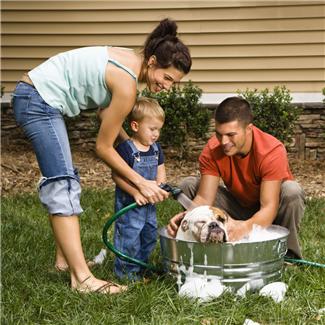 | Joint Attention
|
Get on the child's level.
- You want to be close to your baby and at eye level, so that both of you can attend to the object and listen to the word.
- If you are encouraging your baby to watch your face, then move your face close to the object before you speak.
Follow the child's lead.
- It is best to tune into your baby's attention.
- Babies easily become fascinated with whatever they are exploring.
- They typically do not want to stop at look at something the adult wants to talk about.
- Watch what holds your baby's interest and talk about those things and their actions.
- Follow the baby's lead and give words to match baby's interest.
Label, label, label, all day long.
- Name objects, but not just objects. Language is more than nouns.
- Name actions. Name feelings and reactions.
- Name simple concepts (e.g., how does it look, feel, taste, sound, move?).
- Name them all day long, in as many situations as you can find.
Practice at Home:
Here are some practice examples. There are many things you could say...this gives a few ideas for getting started.
| Child's Actions | We can say and/or sign... | |
|---|---|---|
Teddy Bear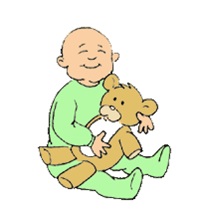 | Baby wakes up and looks at the bear | "There's Teddy Bear." |
| Baby grabs bear. | a. "Hug Teddy Bear." b. "You love your bear." | |
| Baby spills milk on the table. | a. "Teddy Bear is wet." (sniff the bear) b. "Your bear smells like milk!" | |
Shoes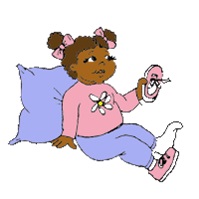 | Baby grabs own shoe. | "There's your shoe!" |
| Baby struggles to get it off. | "You want your shoe off? Pull!" | |
| Shoe comes off. | a. "You got your shoe off!" b. "Do you want your other shoe off too?" | |
Peaches at lunch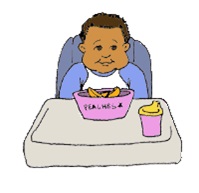 | Baby takes a bite. Possible responses: | a. "Mmmm. Peaches are good." b. "You like peaches." c. "You eat peaches. Yummy." |
| Baby opens mouth for more. Possible responses: | a. "More peaches." b. "Oh, another bite of peaches." c. "Here come the peaches. You want more." | |
| Baby turns head away. Possible responses: | a. "No more peaches?" b. "One more bite, please. Peaches are good." c. "Done with peaches? Okay." |