

Language and Learning
Reading with Young Children Learning Spoken Language
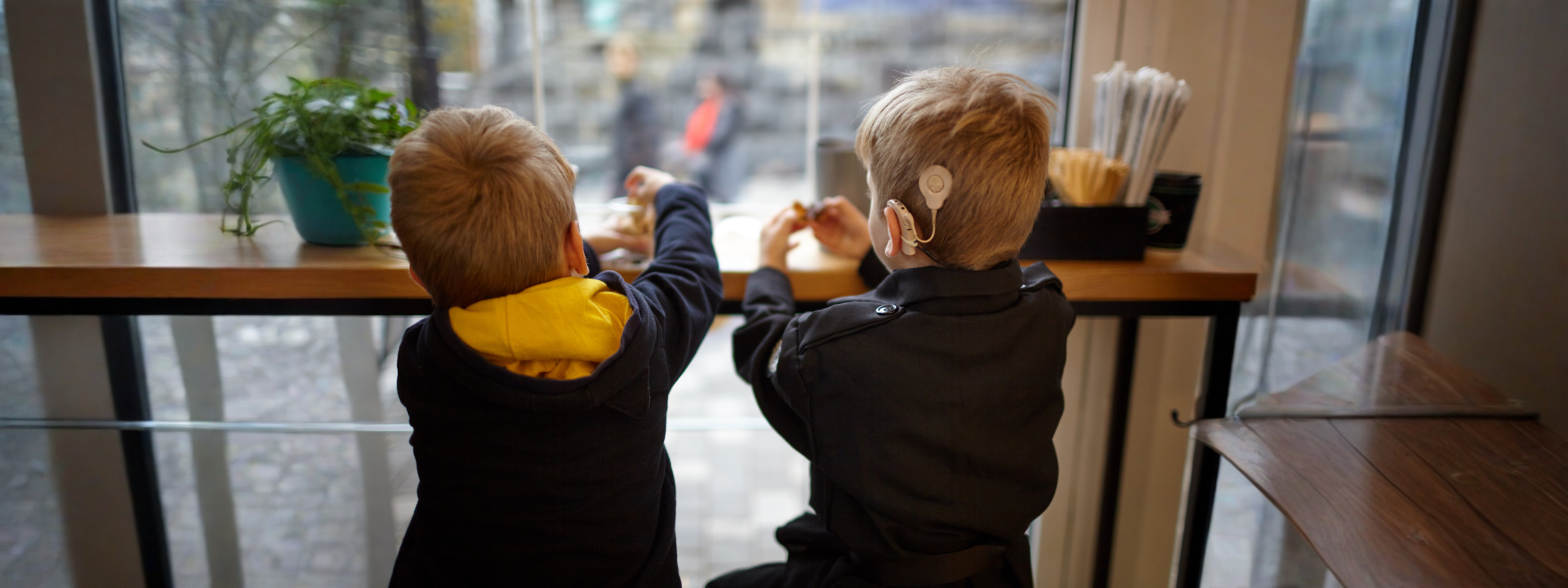
Story time is a time to stay close and communicate about something that is interesting and exciting. Story time is also a time for baby to listen with amplification and begin to make sense of sound.
- Experiencing different sounds in speech: early books call for parents' voices to go up and down, to be loud and soft, squeaky and smooth.
- Identifying different noises and sounds: early books have animal noises, vehicle noises, funny voices and more to help make reading fun
- Practicing listening: this will help your baby develop speech sounds and voice control
Reading is not the only time that you will communicate and your baby will listen, but it is a very important time. Be sure that hearing aid and/or cochlear implant devices are working well so your child is "on the air" for the precious time you will share books together.
Place Yourself Close and Let the Child Look and Listen
Give your baby or your toddler a chance to look at the book and listen to what you are saying.
Some little ones are learning language mostly by listening to what is said. If that is true of your little one, you have some options.
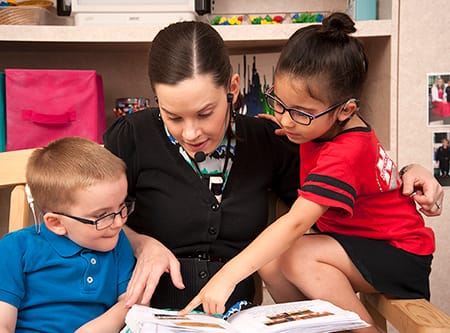
- Sit beside your little one when she is in her high chair. This puts you close to her device microphone and on the same level.
- Speak naturally and colorfully as you talk about the book. She may or may not look at you for more information.
- You may also seat the child in your lap with the book in front of you; if your child sits up straight, you can be close to her device microphones.
- You can repeat and point to help your child connect what is heard with what is in the book.
If speechreading is part of your communication approach, give the child a chance to look at your face.
- You can cue your baby to focus on your face or on the book by pointing, or changing your voice suddenly.
- To do this, you will need to sit in the corner of a couch, or with your baby diagonally in your lap, with the book slightly to the side.
Encourage Your Baby to Communicate About the Book
What is your baby looking at, or pointing to, or trying to say about a picture?
- Because we rarely read books just once, your baby will gradually begin to repeat favorite words and phrases, or correct you if you forget them or say them wrong.
- Communicating about stories and picture books is one of the great pleasures of reading to our babies and children.
- It also is an important part of developing literate language for later reading in school.
Some Strategies for "Tuning In" On Language and Listening
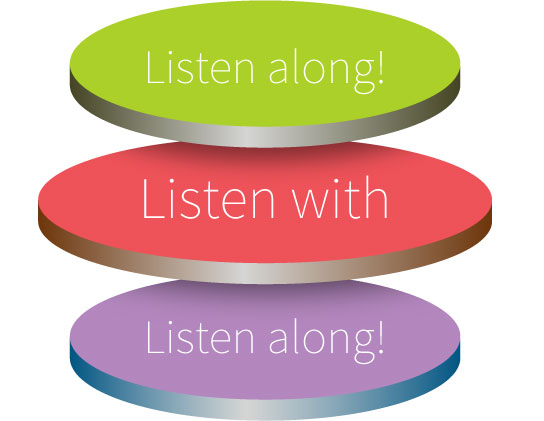
Parents of children who are deaf or hard of hearing use some special strategies to promote listening and understanding. The words in orange are said a little louder with a bit more emphasis.
Tell and Show
Instead of "show and tell" try it the other way around.
For example, if your child is learning the phrase, "turn the page" – you can encourage your child to make this connection by saying, "turn the page." Then wait a moment and show the child what you mean – demonstrate turning the page – while saying, "We can turn the page."
Play with Sound Patterns and Sound Effects
Book reading can be a wonderful time to play with sound effects. When children are learning to listen, these natural sound effects provide interesting patterns and contrasts to listen to. The train says "chooo-chooo-chooo," but the baby says, "WAHHHHHHHH." Bunnies can hop-hop. These sound contrasts are fun and help build sound-meaning associations.
Notice how this little girl is learning the Old MacDonald song after reading the same book with her parents over and over again. Although she does not know or pronounce each word, she is clearly picking up on the melody and enjoying this fun book sharing game.
WAIT for a Response
Sometimes you will say something, and your child just needs a little time to process…to figure out what you said. As adults, we are wise to give the child a little "wait" time. That wait time gives your child an opportunity to think and respond.
Some Final Thoughts
- Children who are deaf or hard of hearing who are learning spoken language need to experience books in a quiet environment – turn off the TV and limit other background noise if you can
- Repeat, repeat, repeat! Children need to hear the words, sounds and stories again and again
- While you are reading, your baby is working hard to make sense out of what you are saying, but the work is fun
- The more you read together, the more your baby can practice listening
- Parents and family members who read regularly to your baby not only help develop listening and spoken language, they help promote literacy
Suggested Readings:
Children With Hearing Loss - Developing Listening and Talking, 2nd Edition, Elizabeth B. Cole & Carol Flexor (Plural Publishing, Inc., 2011)
Literacy and Deafness: Listening and Spoken Language, Lyn Robertson (Plural Publishing, Inc., 2013)